
The digital version of RIOT2026 report
NOTE: we had planned to launch the publication at the ThingsCon Salon Making the Symbiocene on 26 June 2026 in Rotterdam. Due to extreme weather circumstances we needed to delay that event to August 2026 (details will follow asap).
This year, we are publishing again the State of Responsible Technology report, RIOT 2026, in short. Connected to the theme of TH/NGS 2025—RESIZE<REMIX<REGEN. Last year, we rebooted that tradition and were very happy with the result, receiving a lot of positive feedback on the publication (have a look at it here).
We launched the first RIOT report in 2017 and published three more editions in the years after. Last year, we restarted it after a short break. RIOT 2026 is the sixth edition.
We invited everyone, both practitioners, academics, and other professionals, to send in their proposals for articles that relate to the theme. Read more about the theme below.
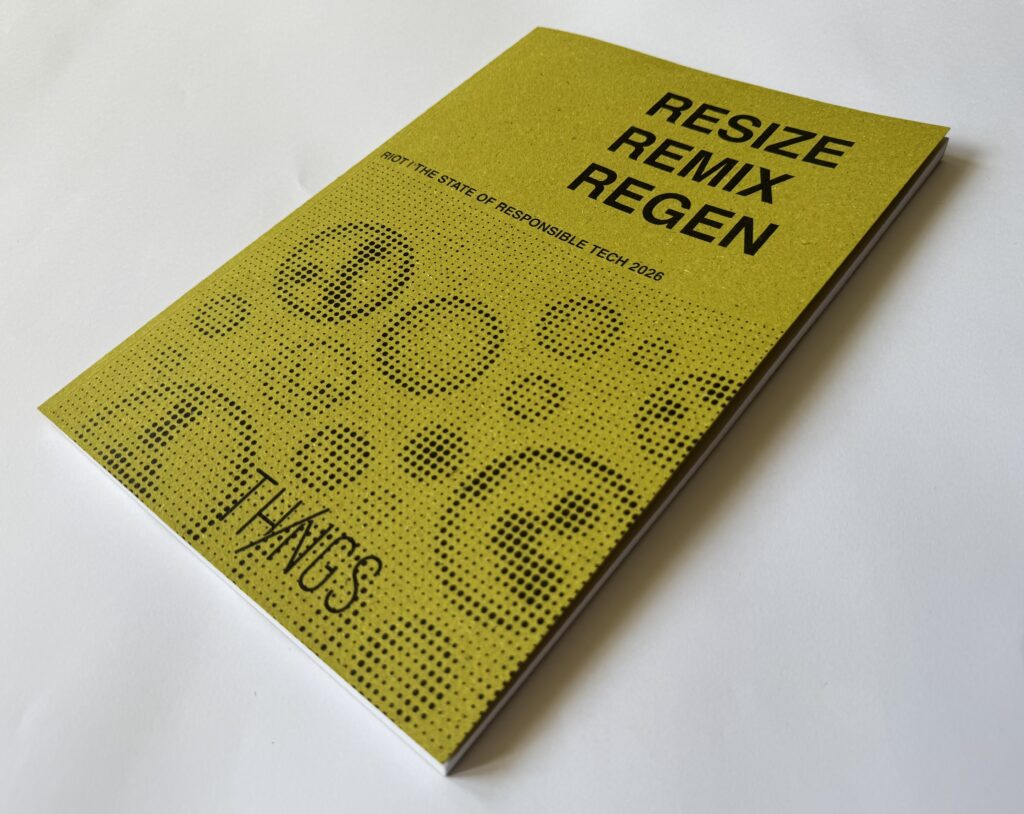
RIOT 2026
We are very happy to launch RIOT 2026, the ThingsCon report on the state of responsible technology. This sixth edition follows the theme of RESIZE<REMIX<REGEN as we introduced it at our last conference on 12 December 2025. We have a collection of 10 articles by authors from practice and academia that reflect on the theme. Next, we present the four student projects that received the public vote at the conference. You can download the publication from our website from today.
(…) annual report does not see itself as a celebration of the next big thing. It is a stock-taking exercise and a challenge. It brings together positions, projects and questions from a community that neither rejects nor romanticises technology. It asks what an Internet of Things, an AI, a city, an object, an interface or an infrastructure would have to look like if they were not based on extraction, acceleration and displacement. It asks which methods we must unlearn and which new alliances might emerge. Between design, technology, research, politics, education, civil society and the living systems on which every future depends.
From the editorial introduction by editors Iskander Smit and Andrea Krajewski.
Smit, I., & Krajewski, A. (2026). ThingsCon State of Responsible Technology 2026 – RESIZE<REMIX<REGEN. https://doi.org/10.5281/zenodo.20569440
The articles of 2026
Taken from the editorial introductory, the articles introduced.
Sen Lin opens with a foundational claim: artefacts are never neutral. They shape social rules, power relations, and possibilities for action. Designers therefore face a choice: avoid harm defensively or actively design toward fairer alternatives. This political framing sets the stage for what follows.
Martijn van Loon makes the political concrete through an everyday yet invisible problem: digital waste. “Invisible debris” confronts the myth of immaterial data, tracing cloud storage through electricity, water, server space, and raw materials. If data has weight, design must develop systems for decay, limitation, and conscious archiving. Joanna Montgomery then shifts from ecological materiality to emotional materiality. “The things we cannot throw away” asks what happens when connected products outlast their technical usefulness but continue to hold meaning. It witnesses intimate moments for which design has developed neither language nor rites of passage.
From objects to systems. Phil van Allen‘s “Uneasy symbionts in the clearing” anticipates the cooling of AI hype as an opportunity: a chance to stop treating AI as a tool that performs tasks and start seeing it as entangled with people, infrastructure, environment, and other living beings. Iskander Smit deepens this reframing, arguing that regenerative AI is not about making large models slightly less harmful but about redesigning intelligence itself as smaller, local, relational, and collectively accountable. Kars Alfrink, Sunjoo Lee, Lena Trotereau, and Fieke Jansen bring this debate down to earth in “Mud and models,” grounding speculative AI futures not in abstract scenarios but in mud batteries and embodied making.
Maja Riemann‘s “Arcane designing” radically expands the space of possibilities, proposing magic, fantasy, and folkloric worldviews as legitimate design materials — challenging the Western separation of human, body, and Earth. Albrecht Kurze then turns to methodology: if there is no universal IoT design method, we might as well start Frankensteining: deliberately breaking down, adapting, and reassembling existing tools to the context rather than convention. Maarten Lens-FitzGerald and Rob van Kranenburg translate this methodological flexibility to infrastructure policy in “Kenner futures”, where citizens shape 6G networks through backcasting workshops, reimagining mobile infrastructure as democratic commons.
The collection closes with “The oracle of Chemnitz” by Karola Köpferl and Albrecht Kurze. It is a concrete, sensory demonstration of what RESIZE, REMIX, and REGEN can look like in urban space: an old garage transformed through retro technology and storytelling into a site where forgotten artefacts and new cultural life.
Together, these ten contributions do not converge on a single answer. They circle the same questions from different angles: What scales t? What already exists that we could work with? What might we restore rather than merely sustain? The conversation continues.
Overview of the articles
In order of appearance in the report.
Sen Lin (2026), The Politics of Design, in The State of Responsible Technology RESIZE<REMIX<REGEN, Stichting ThingsCon Amsterdam, p. 08-11 https://doi.org/10.5281/zenodo.20569440
Key premise: Design is never neutral; rather, it shapes power, behaviour and social norms.
> Article PDF
Martijn van Loon (2026), Invisible Debris: Rethinking digital waste in an era of perpetual storage, in The State of Responsible Technology RESIZE<REMIX<REGEN, Stichting ThingsCon Amsterdam, p. 12-16 https://doi.org/10.5281/zenodo.20569440
Illustrates political responsibility through an everyday yet invisible problem: digital waste, cloud storage and resource consumption.
> Article PDF
Joanna Montgomery (2026), The Things We Cannot Throw Away, in The State of Responsible Technology RESIZE<REMIX<REGEN, Stichting ThingsCon Amsterdam, p. 17-22 https://doi.org/10.5281/zenodo.20569440
Shifts from ecological materiality to emotional materiality: objects are not merely resources, but vessels of memory and meaning.
> Article PDF
Phil van Allen (2026), Uneasy symbionts in the clearing, in The State of Responsible Technology RESIZE<REMIX<REGEN, Stichting ThingsCon Amsterdam, p. 23-28 https://doi.org/10.5281/zenodo.20569440
Opens up the broader AI framework: beyond the hype, we need a different understanding of AI as part of complex ecologies.
> Article PDF
Iskander Smit (2026), Rethinking intelligence: immersive AI and the regenerative turn, in The State of Responsible Technology RESIZE<REMIX<REGEN, Stichting ThingsCon Amsterdam, p. 29-33 https://doi.org/10.5281/zenodo.20569440
Deepens this idea and shifts AI from centralised largescale systems to local, relational and
> Article PDF
Kars Alfrink, Sunjoo Lee, Lena Trotereau, Fieke Jansen (2026), Mud and Models: Does Making Matter for Regenerative AI Speculation?, in The State of Responsible Technology RESIZE<REMIX<REGEN, Stichting ThingsCon Amsterdam, p. 34-40 https://doi.org/10.5281/zenodo.20569440
Brings the AI debate down to earth: making, mud batteries and ‘Grounded Futures’ show how speculative design can be materially anchored.
> Article PDF
Maja Riemann (2026), Arcane Designing: On the regenerative potential of magic, in The State of Responsible Technology RESIZE<REMIX<REGEN, Stichting ThingsCon Amsterdam, p. 41-48 https://doi.org/10.5281/zenodo.20569440
Radically expands the space of possibilities: magic, fantasy and more-than-human worldviews as a resource for regenerative design imagination.
> Article PDF
Albrecht Kurze (2026), Resize, Remix, Regen: Frankensteining IoT Design Methods, in The State of Responsible Technology RESIZE<REMIX<REGEN, Stichting ThingsCon Amsterdam, p. 49-58 https://doi.org/10.5281/zenodo.20569440
Makes the transition to methodology: how can existing design methods be practically deconstructed, combined and revitalised?
> Article PDF
Rob van Kranenburg, & Maarten Lens-FitzGerald (2026), Kenner Futures: Backcasting a New Deal for Mobile Infrastructure, in The State of Responsible Technology RESIZE<REMIX<REGEN, Stichting ThingsCon Amsterdam, p. 59-66 https://doi.org/10.5281/zenodo.20569440
Translates the methodological question into infrastructure policy: 6G is reimagined as the commons, a citizen-led process, and democratic infrastructure.
> Article PDF
Karola Köpferl and Albrecht Kurze (2026), The Oracle of Chemnitz: An interactive art installation to reanimate old things in a garage featuring a rotary phone, in The State of Responsible Technology RESIZE<REMIX<REGEN, Stichting ThingsCon Amsterdam, p. 67-83 https://doi.org/10.5281/zenodo.20569440
Demonstrates a concrete, sensory, local implementation of remix, reuse and regeneration in urban space.
> Article PDF
Next to these articles, Peet Sneekes collected hot takes at the conference and describes his process. Two teams from the Master Digital Design, Amsterdam University of Applied Sciences are shared: Doctor Diagnose and Rooted in You. And also two projects from minor Interactive Environments, Industrial Design Engineering, Delft University of Technology: Symphony of the Servos and Echo of Expectation.

Theme and format
As we connect this to the last conference, the theme of RIOT 2026 will be RESIZE<REMIX<REGEN. This is what we briefed our authors.
Against the backdrop of global tech monopolies obsessed with disruption, we propose a different path: resizing our technological ambitions toward the local and tangible, toward things built to last and evolve within communities. We’re remixing existing materials and knowledge—both digital and physical—privileging repair cultures and collaborative making over extractive consumption. Most critically, we want to explore what happens if we push beyond sustainability toward active regeneration, and create things that restore rather than deplete?
We invite makers, designers, and thinkers to reimagine the creation of things through deliberate restraint, mindful reuse, and regenerative practice
RESIZE; scale, enoughness, and slowing down
REMIX: mashups, play, and cultural hacking
REGEN: regeneration, about repair, nature, healing systems
In our editorial introduction we reflected on the theme and the articles. You can find it as a separate PDF.
Colophon
Published by Stichting ThingsCon Amsterdam, June 2026
Curation, editing: Iskander Smit
Design, editing: Andrea Krajewski
This publication is licensed under the Creative Commons AttributionNonCommercial-ShareAlike 4.0
Unported (CC BY-NC-SA 4.0).
To view a copy of this license, visit www.creativecommons.org/licences/by-nc-sa/4.0
Acknowledgements
The printed version of this publication was made possible by the financial support of IMDF, Interactive Media Design Förderverein e.V., Darmstadt/Germany and Simplications (BMFTR FKZ 16KIS1868K at Chemnitz University of Technology, Chemnitz/Germany.
We would like to thank all our dedicated contributors for sharing their ideas and projects with the ThingsCon community, thereby highlighting a path towards responsible design and development in the face of the emerging technologies that are otherwise increasingly shaping our world.